AM Best flags $30 billion of fronting premium backed by unrated reinsurance
Conning's August 2026 study found fronting programs' initial loss ratios developed adversely in each of the past seven accident years.

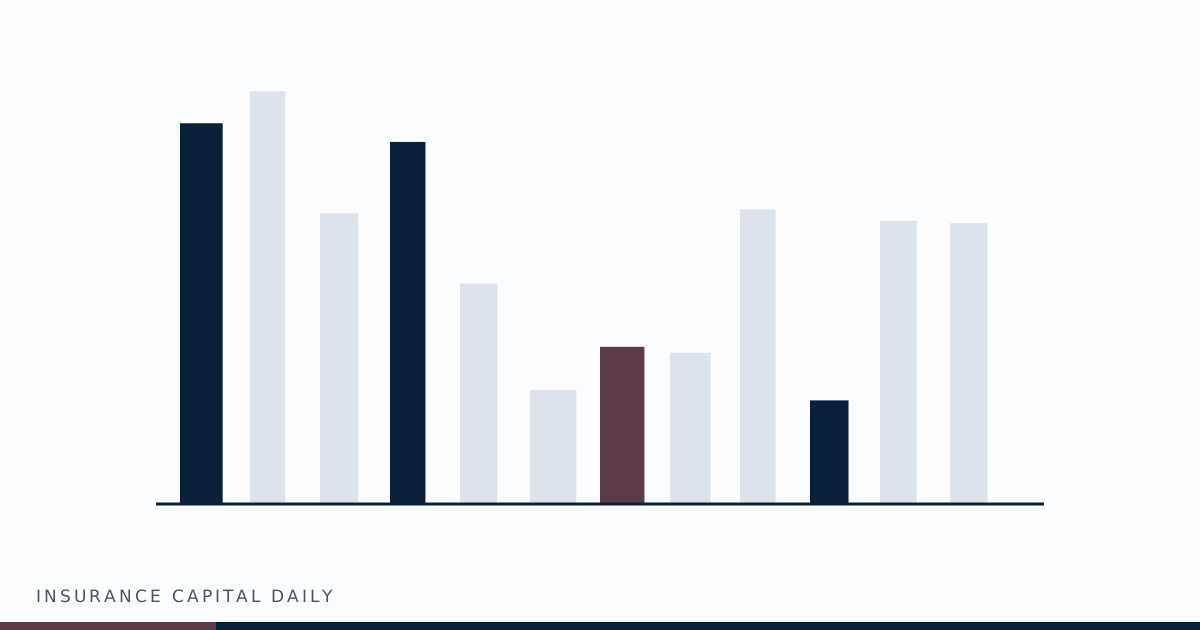
AM Best has put a number on a problem that had mostly been visible program by program: $30 billion of fronting premium resting on reinsurance the agency does not rate. Conning's August 2026 study, reported alongside the finding, supplies the record behind it, showing fronting programs' initial loss ratios developed adversely in each of the past seven accident years.
Seven consecutive years is not a one-off. An initial loss ratio is the first estimate of what a book will cost, and adverse development on it means the estimate came in low; a single year of that is a pricing miss, but seven consecutive accident years is a pattern, and the pattern points away from the price of the risk and toward the party holding it.
The loudest discipline test in reinsurance is the property catastrophe renewal, where the rate has to cover the modeled loss, and the fronting findings move part of that test somewhere far less visible. The test shifts from whether the exposure was priced correctly to whether the reinsurer standing behind the program can pay when the first estimate proves light. For $30 billion of fronting premium, the reinsurance in that position is unrated, which places it outside the surveillance that cedents, regulators and rating committees lean on; the exposure would otherwise be discussed program by program, if at all.
Seven accident years
Fronting programs put a licensed carrier's paper in front of risk and lay most of the exposure off to reinsurers, which is why the balance sheet behind the program, not the name on the policy, is what ultimately stands between a claim and a recovery. When that reinsurance is rated, a committee is watching its reserves, capital and concentration; when it is not, the discipline has to come from somewhere else: the program's own underwriting, its collateral terms, the MGA's willingness to keep writing when the loss ratio moves the wrong way.
Conning's seven-year finding says that discipline has not held reliably. The study does not say why, and nothing in the coverage indicates whether the adverse development is concentrated in a few programs or spread across the market, but it does establish that the first look at these books has been optimistic year after year, precisely the quality a cedent or a regulator would want to see before trusting the layer above the paper.
The pattern is hard to dismiss for a second reason: an initial loss ratio is not just a number in a filing but the input that shapes collateral, trust and the terms on which a cedent will let a program write its paper. When that figure is low for seven straight years, the error compounds through the whole structure above it.
Continue this analysis
Get the complete Insurance Capital Daily analysis and every detail that follows.
Enter a valid work email to continue reading.
Already a reader? Sign inInsurance Capital Daily's daily briefing. Unsubscribe anytime.
 The Wrap
Talcott Resolution completes $6.3bn Lincoln guaranteed universal life reinsurance
 The Wrap
Zurich completes $10.7 billion Beazley acquisition and names Terryn specialty CEO
 The Wrap